What the simulator shows
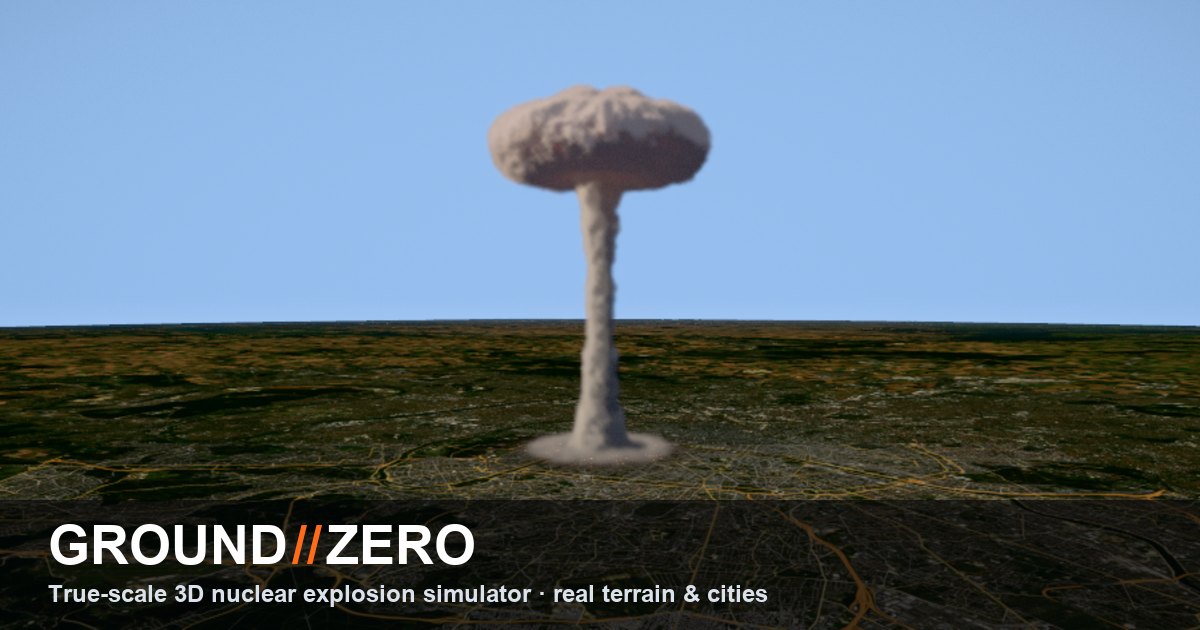
GROUND//ZERO is a free, open-source nuclear detonation simulator that runs in the browser with WebGPU. Unlike flat blast-radius maps, it renders the event in 3D on a Google-Earth-like globe:
- The flash and fireball: a blackbody fireball that blinds the camera, then rises and rolls into a toroidal vortex.
- The shockwave: a refracting pressure front that flattens buildings inside 20 psi and damages them down to 5 psi.
- The mushroom cloud: a volumetric cloud with its dust stem and base surge, reaching its real height, then drifting with the upper-level wind and dissipating.
- Fires: smoke plumes and flames across the thermal radiation zone, kept off rivers, lakes and the sea.
- Sound: silence after the flash, then the blast and a rolling thunder arriving with their real delay for your distance.
Blast radius of famous nuclear weapons
Effects follow the empirical scaling laws of Glasstone & Dolan, The Effects of Nuclear Weapons (1977), for an airburst at the optimal height:
| Weapon | Yield | Fireball | 5 psi (buildings collapse) | 3rd-degree burns | Cloud top |
|---|---|---|---|---|---|
| Little Boy (Hiroshima) | 15 kt | 177 m | 1.2 km | 2.1 km | ≈ 13 km |
| B83 (US gravity bomb) | 1.2 Mt | 1.0 km | 5.2 km | 12.6 km | ≈ 34 km |
| Tsar Bomba | 50 Mt | 4.5 km | 17.9 km | 53.9 km | ≈ 65 km |
Frequently asked questions
How far does a nuclear blast reach?
It depends on the yield: blast radii grow with the cube root of the yield. A Hiroshima-size 15 kt bomb collapses houses out to about 1.2 km and breaks windows out to 3.1 km; a 1.2 Mt weapon collapses houses out to about 5 km.
Why does the sound arrive after the flash?
Light is instantaneous at these distances, but the shock wave travels at roughly the speed of sound. 20 km away, the blast arrives about a minute after the flash — the simulator reproduces that silence.
How long does a mushroom cloud last?
It stabilises within minutes, then the upper-level wind tilts its stem and carries the cap away; it spreads, thins and dissipates within roughly twenty to thirty minutes.
Is the simulation accurate?
Radii follow published scaling laws; casualty figures use a simplified population-density model. It is an educational visualisation, not a planning tool.
Free and open source
The simulator is free, needs no account and runs entirely in your browser. Its code is published under the MIT license on GitHub. Map data: Sentinel-2 cloudless (EOX), AWS Terrain Tiles, OpenFreeMap / OpenMapTiles © OpenStreetMap contributors.